
Zapier enables you to create automations, or Zaps, for various applications based off of actions in your CoreBridge system. It can also be used to automate actions in your CoreBridge system, such as creating a Contact, using outside applications. All automations, or Zaps, begin with triggers.
What is a Trigger?
A Trigger is the event that starts a new automation, or Zap. When the specified event happens in one app, such as a Contact being created, it will trigger the automation to start. Triggers also allow you to return an Array of Objects while Actions/Searches can only return one.
Example:
1. A Zap is created with a Trigger of "Contact Created"
2. A new Contact is created in CoreBridge
3. A Webhook provides the update to Zapier
4. Zapier notices the new Contact and triggers your Zap
Note: Each Zap can have one Trigger, with one or more Actions that follow.
Using a Trigger within a Zap
Various Triggers can be used to create a Zap. For this example, "Create Contact" will be used.
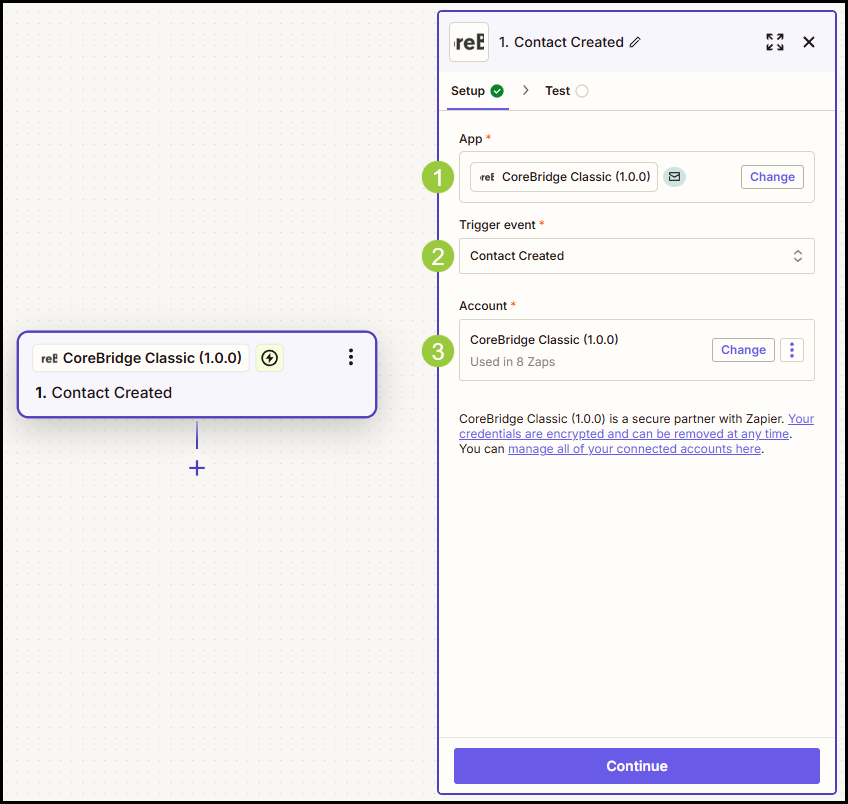
1. Select the "CoreBridge Classic" App.
2. Select "Create Contact" as the Trigger Event.
3. Select your CoreBridge Classic Account
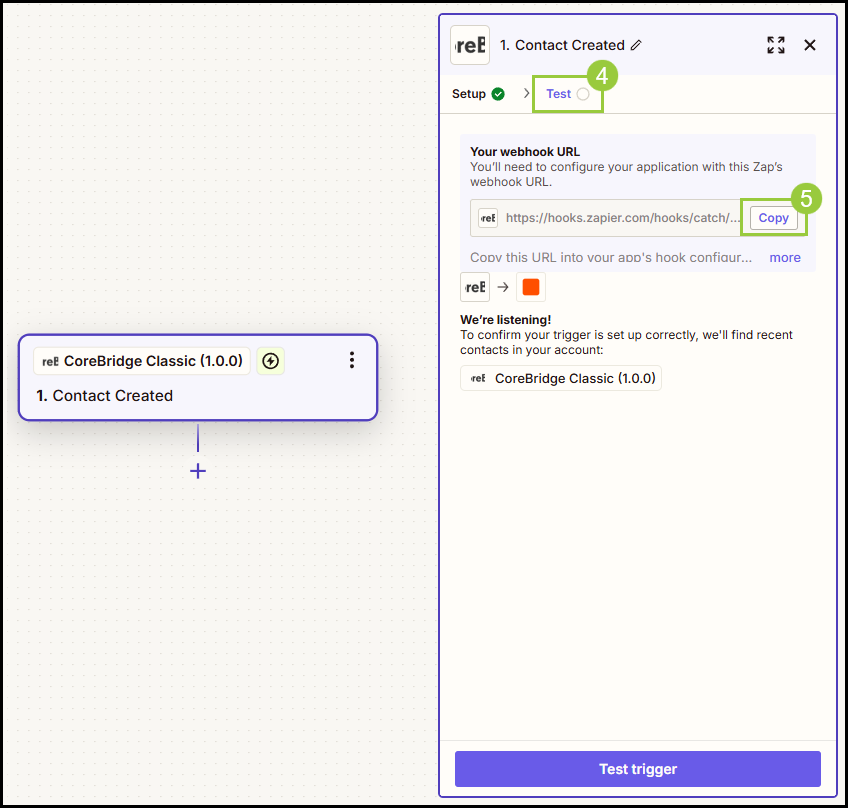
4. Navigate to the Test tab.
5. Copy the Webhook URL supplied by Zapier.
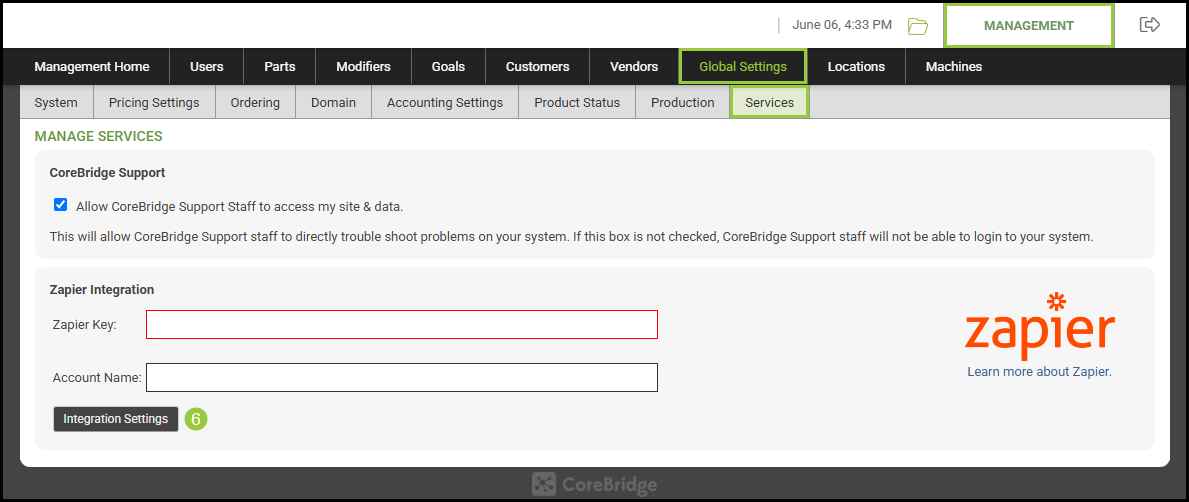
6. Navigate to Management / Global Settings / Services / CoreBridge Classic Zapier Integration / Integration Settings in your CoreBridge system.
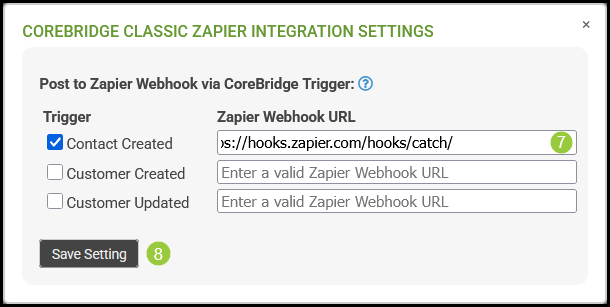
7. Paste the URL supplied by Zapier into the Zapier Webhook URL field, ensuring the trigger is enabled.
8. Click Save Setting.
To ensure the Trigger is working, we recommend creating a new Contact in your CoreBridge system. Once created, you can check in the Test tab within your Zap. New Contacts should be displayed at the bottom if connected correctly.
When clicking on a Contact from within a Zap, you can expect to see field such as an ID, name information, contact information, location information, and more.
A properly working Trigger can then be paired with a following Action to create a full automation, or Zap.
Available Triggers
Triggers are organized into four categories to help you target specific actions: Contact, Customer, Estimate, and Order.
Contact Triggers -
1. Contact Created Trigger
- Description: Fired when a new Contact is created in CoreBridge.
- Use Case: Automatically start workflows when a new contact is added, such as sending welcome emails or updating CRM records.
2. Contact Updated Trigger
- Description: Fires when an existing Contact is updated in CoreBridge.
- Use Case: Track changes to contact information and trigger follow-up actions like notifications or data syncing.
Customer Triggers -
3. Customer Created Trigger
- Description: Fires when a new Customer is created in CoreBridge.
- Use Case: Automate tasks that should happen when a new customer record is added, such as sales notifications.
4. Customer Updated Trigger
- Description: Fires when an existing Customer is updates in CoreBridge.
- Use Case: Respond to customer data changes with alerts, updates in other systems, or analytics tracking.
Estimate Triggers -
5. Estimate Created Trigger
- Description: Fires when a new Estimate is created in CoreBridge.
- Use Case: Initiate Estimate review workflows, otify sales teams, or automatically sync Estimate data to integrated systems.
6. Estimate Cancelled
- Description: Fires when an existing Estimate is cancelled.
- Use Case: Trigger follow-up actions such as notifying sales reps, updating pipeline analytics, or prompting re-engagement sequences.
7. Estimate Converted to Order
- Description: Fires when an Estimate is successfully converted into an Order.
- Use Case: Start onboarding workflows, notify production teams, or trigger downstream automations dependent on order creation.
Order Triggers -
8. Order Created
- Description: Fires when a new Order is created in CoreBridge.
- Use Case: Begin fulfillment workflows, notify production staff, or sync order data with external systems.
9. Order Built
- Description: Fires when an Order is marked as built.
- Use Case: Trigger quality checks, update logistics systems, or notify team members responsible for the next stage.
10. Order Completed
- Description: Fires when an Order is marked as completed.
- Use Case: Notify Customers, initiate invoicing workflows, or update performance analytics.
11. Order Closed
- Description: Fires when an Order is officially closed.
- Use Case: Trigger archival processes, update reporting metrics, or notify account managers.
12. Order Voided
- Description: Fires when an Order is voided.
- Use Case: Prompt internal reviews, update sales tracking tools, or notify stakeholders of changes in Order Status.